Print Design and Receipt Templates
Use a prepared 80 mm or 58 mm layout, or customise a receipt, quotation, statement, order slip or other form with the print designer. You can move items freely, choose columns and fonts, add a logo, and design for A4 or other paper sizes.
Your existing designs are kept. Upgrading does not replace saved forms. Applying a template, copying a design or clearing the page changes a draft. Click Save to replace the saved design. Preview and Test print do not save it.
Open a design
- In Back Office, open Home > Set Up and Settings > Settings > Printing.
- Select the exact form you want to change. Retail Receipt, Retail Customer Receipt and Intermediate Bill, for example, have separate designs.
- Click Edit Print Design For Selected Print Document.
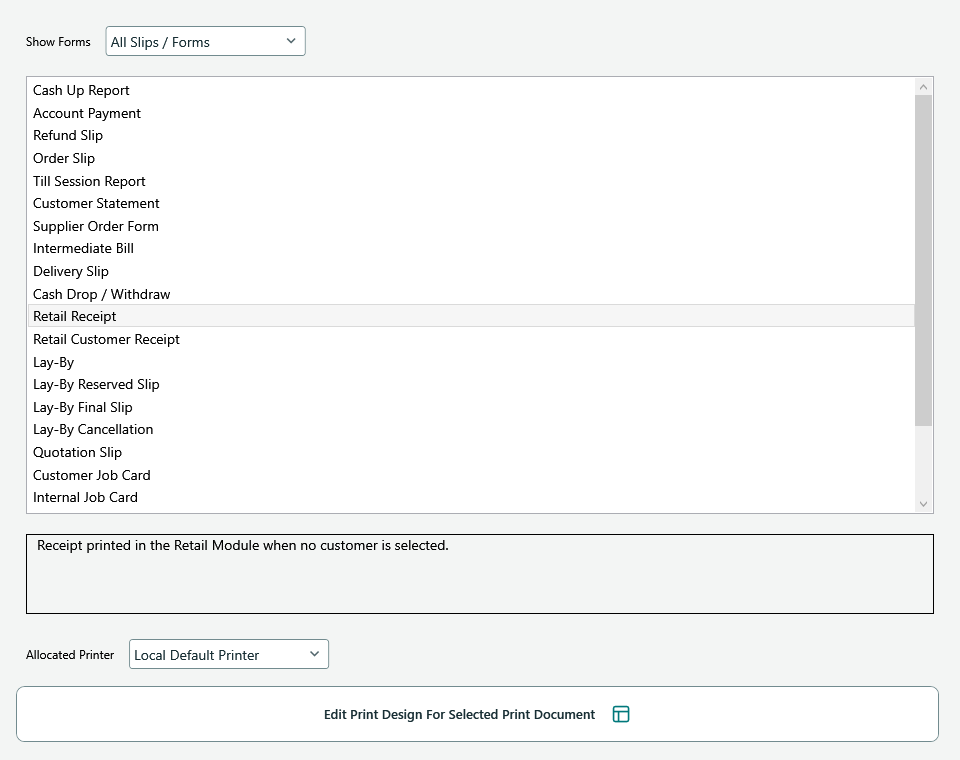 Select the form first. Allocated Printer chooses its printer; Edit Print Design opens its layout.
For printer allocation and printing from multiple computers, see POS Printers. Department order slips use Department Printers.
Start with an 80 mm or 58 mm template
- Choose 80 mm or 58 mm in the list beside Apply template.
- Click Apply template. The template replaces the current draft and sets the matching paper width.
- Select the shop-name text on the page and enter your business name in Text / image name. Edit the telephone, VAT details and any footer text in the same way.
- Use Preview to check the result, then Save when ready.
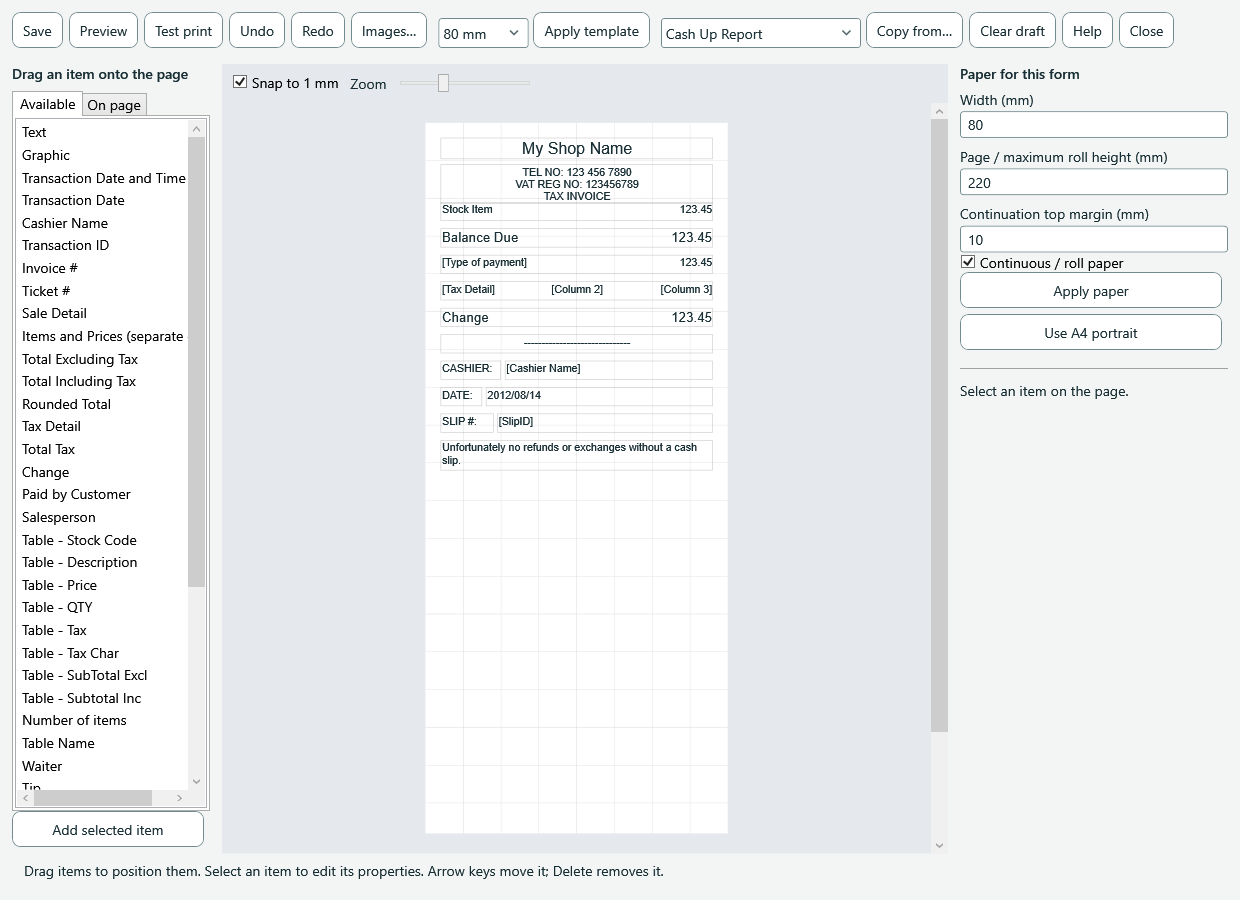 The 80 mm template. Available items are on the left, the page is in the middle and paper settings are on the right.
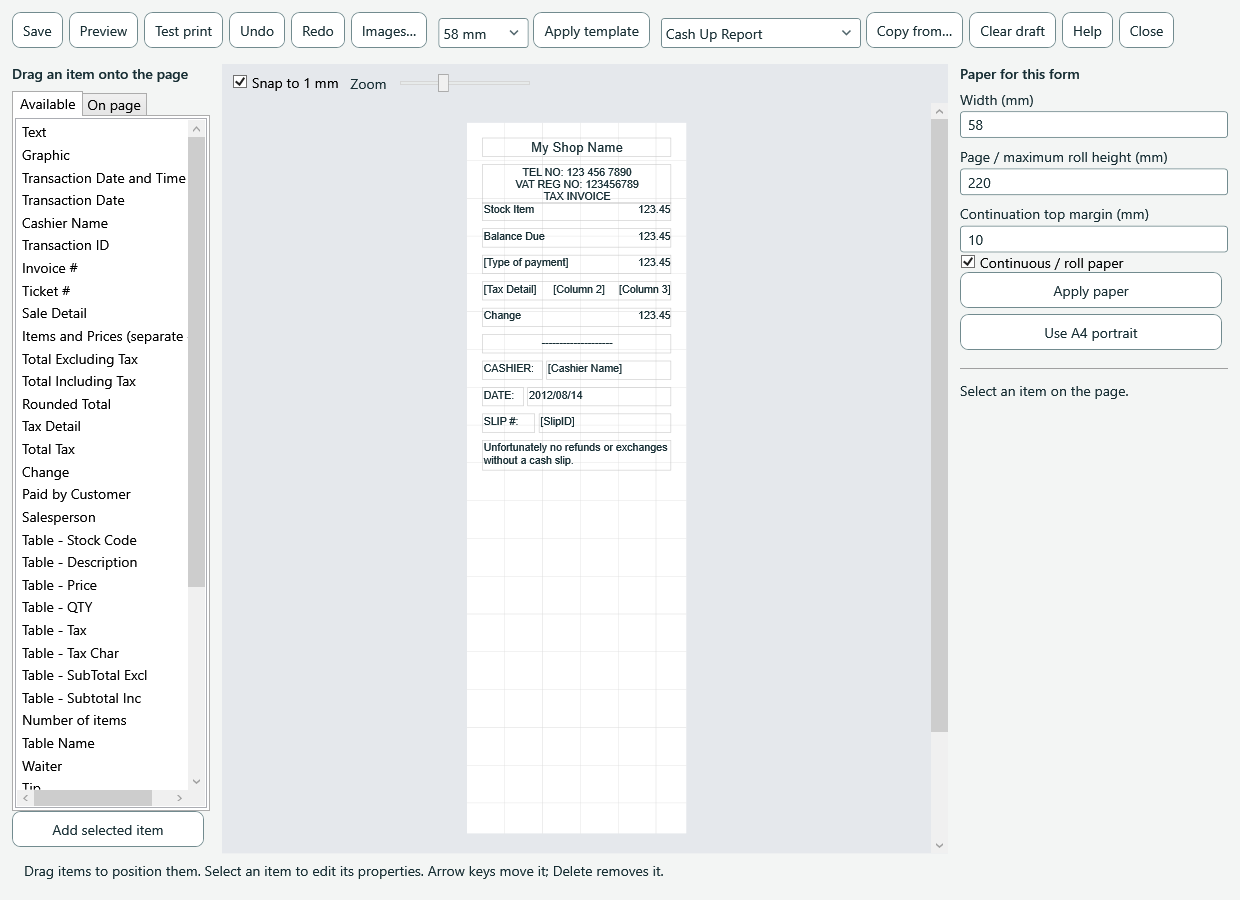 The 58 mm template uses a narrower layout. Choose the size that matches your printer roll.
Both template sizes are available for every form. New databases start with the 80 mm layouts. Templates are fully editable: you can remove, duplicate or move items afterward. Use Undo if you apply a template by mistake.
Add, move and edit items
- Drag an item from Available onto the page. You can also double-click an available item or use Add selected item.
- Drag an item already on the page to move it. Use the grid, Snap to 1 mm and Zoom controls to help position it.
- Select an item on the page or in the On page tab. Its properties appear below the paper controls.
- Enter the required values and click Apply item changes. Selecting another item, Save and Preview also apply pending item edits.
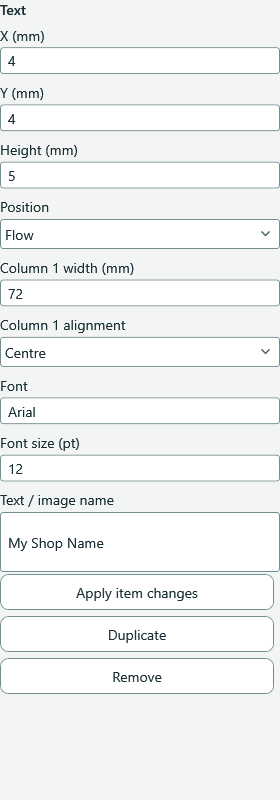 The properties of the shop-name text item. Scroll the right panel if a control is below the visible area.
| Property | What it controls |
|---|
| X and Y | The item position in millimetres. X moves it across the page; Y moves it down the page. |
| Height | The image height or the specified row height for individual table items. Text and standard detail rows are measured when printed. |
| Column width and alignment | The width in millimetres and Left, Centre or Right alignment for each column. Multi-column items show a separate pair of controls for every column. |
| Font and font size | The font name and size in points. |
| Text / image name | Editable wording for Text items and supported total labels, or the saved image name for a Graphic. Transaction values such as the cashier and sale number are supplied automatically. |
A text item can contain up to 300 characters, including line breaks. Use Duplicate for another copy of an item, and Remove or the Delete key to remove it. The arrow keys move a selected item by one millimetre. Undo and Redo also cover dragging, templates, copying and clearing the draft.
Background, fixed and flow placement
- Background: prints behind other items, for example a stationery image.
- Fixed Y: keeps the positioned Y value rather than moving down with growing detail. Use it for a positioned item on a fixed-height page.
- Flow: items after growing sale, payment or report detail move down by the detail height.
Fixed items are placed on the first page; they are not repeating page footers. Ordinary text does not automatically push the following items down, so leave enough space for long business names, addresses and notes.
Table items let you choose individual sale columns such as stock code, description, quantity, price and tax. Keep the columns on the same row and use matching heights so their rows stay aligned. Allow enough height for wrapped descriptions. Standard Sale Detail and other combined detail items measure their row heights automatically.
Paper size and A4
- In Paper for this form, enter Width (mm) and Page / maximum roll height (mm).
- Enter the Continuation top margin (mm), which is the space above content on later pages.
- For cut-sheet paper, clear Continuous / roll paper. The Use A4 portrait button sets 210 by 297 mm and a 10 mm continuation margin.
- Click Apply paper, then Save to keep the settings for this form.
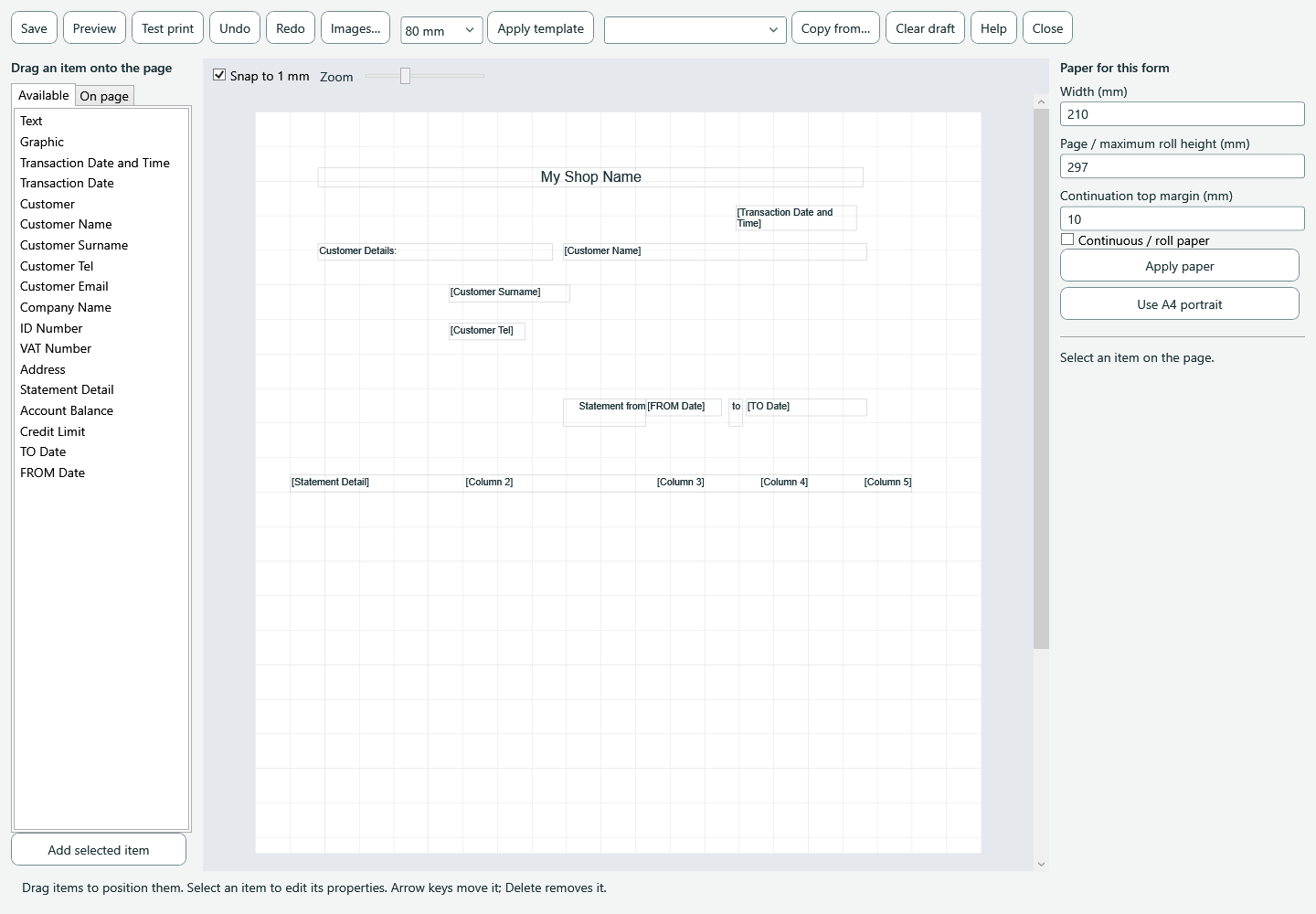 An editable statement draft on A4. Changing the paper size does not automatically resize or reposition its items.
There is no supplied A4 template. You can widen the columns and position the existing items for A4, use another saved design as a starting point, or clear the draft and add your own items. Enter width and height manually for other paper sizes or orientations.
The supplied roll templates end a receipt shortly after its content, up to the configured maximum height. Longer content continues onto another page. Existing designs retain their previous paper behaviour; applying a template is optional. Match the printer driver's paper size to your design and check the result on that printer. The printable area can be narrower than the roll width.
Copy between forms
- Open the destination form's designer.
- Choose the source form in the list beside Copy from..., then click that button.
- Review the copied draft. The message below the page shows how many items were copied and how many unsupported items were ignored.
- Edit any remaining text labels, check the paper settings, preview and Save.
The source design is unchanged. Supported items and the source paper settings are copied; unsupported transaction fields are ignored. Ordinary text labels remain ordinary text, so a label for an omitted field may need removing. Copying a design does not change the destination form's allocated printer. Undo restores the previous draft.
Export and import between shops (full edition)
- At the source shop, open the form's designer and click Export.... Choose where to save the .rtprint file. The file contains the current draft, paper settings and images used by that draft.
- Transfer the file to the other shop, for example on a USB drive. No online connection is needed.
- At the destination shop, open the form you want to change, click Import..., and select the file. Confirm replacement of the current draft.
- Check shop-specific text, logos, paper size and fonts, then Preview and Save. Import uses the same supported-field rules as Copy from; the message reports any ignored fields. Undo restores the previous draft.
Export and import require the full edition at both shops. Imported images receive separate names so existing images and other forms are not overwritten. The imported design and images are saved together only when you click Save; closing without saving discards the imported draft. Printer allocations remain local, and fonts are not included in the file.
Images and logos
- Click Images... to open the image library.
- Click Browse image..., choose a PNG, JPG, JPEG, BMP or GIF file, and enter a name beside Save image.
- Click Save image. Select the saved image and click Use selected when adding or editing a Graphic item.
- Set the graphic's X, Y, width and height in the designer. Save the design when finished.
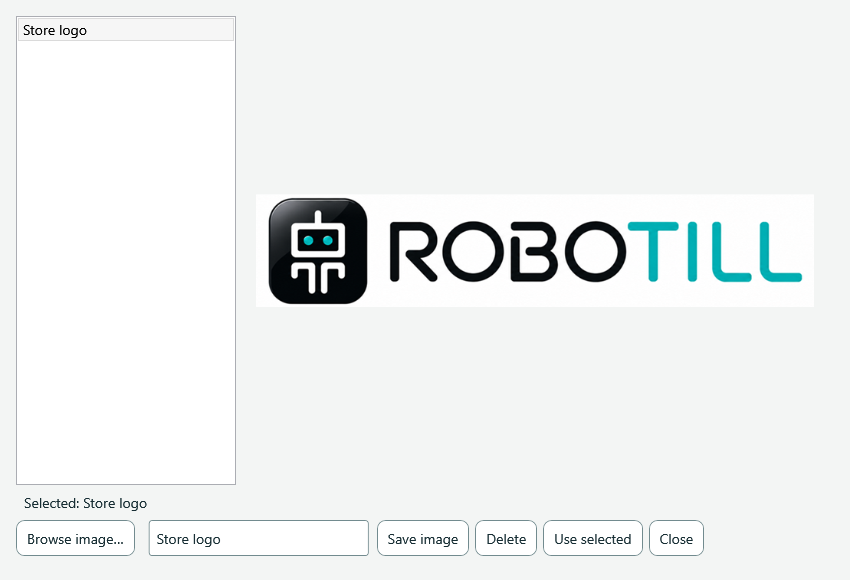 The image library. The sample image is shown for illustration; choose your own business logo.
Image-library changes are saved immediately. Replacing a named image changes it in every design using that name. Closing the designer without saving does not undo an image replacement. The manager prevents deletion of images used by saved designs.
Print images are stored in the database, so the original file is not needed for printing. The application's system logo is separate and is selected under Display Settings; changing that logo does not automatically add a graphic to a receipt.
Preview, test print and save
- Click Preview to render the draft with sample transaction data. It uses the same printing code as the form.
- Click Test print to choose a printer and print the sample. This does not change the form's Allocated Printer setting.
- Click Save to keep the design and its paper settings. Closing an unsaved draft lets you discard those design changes.
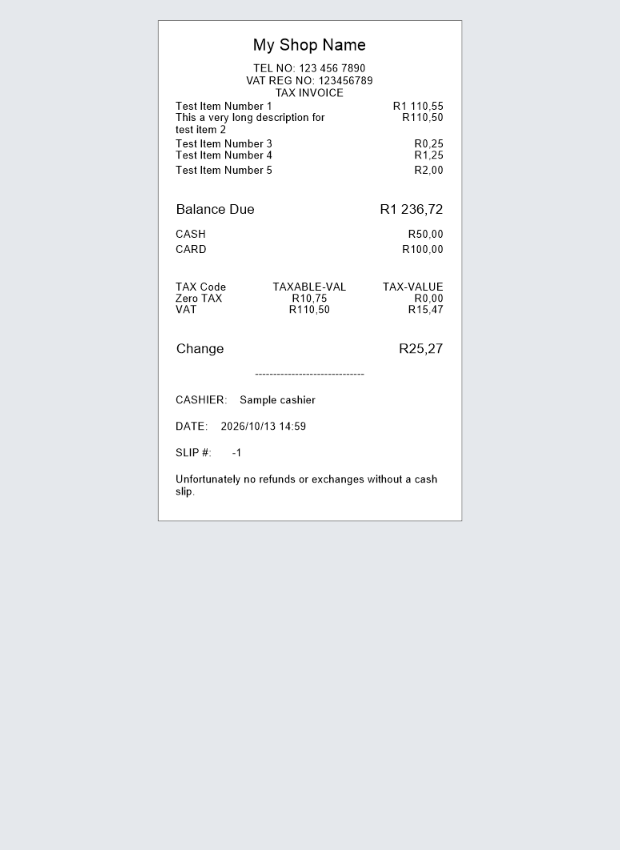 Preview shows the printed result rather than the designer placeholders and grid.
Preview uses sample data, not your current sale. Check real receipts with long descriptions, multiple payment methods and many items as well. For clipping, unexpected page breaks or missing output, see Printer Problems.